As a minister, the greatest joy is seeing a community rally together to fight for what’s right. Tent City does that in downtown Toledo Ohio every year. Started in 1990, and a product of 1Matters.org, Tent City is an annual weekend-long event that aims to bring together the unhoused or marginally housed with some of the community resources in Toledo, fighting systemic poverty. In short, it raises awareness for homelessness, while providing critical resources to those who need it most.
Serving around 1,000 people, I was one of the 400 volunteers this year, assisting with the Free Medical Clinic (offered by ProMedica and University of Toledo) and the Lucas County Health Department’s Free Vaccine Clinic.
There is more than just free medical care that is offered. Tent City also provides dental care, food, clothing, help for those returning to housing, critical document assistance, Veteran’s services, haircuts, literacy programs, and other services to those in need. I saw hundreds of meals being served last night, as well as today – a community simply enjoying being in community.
What I saw was one big event of people coming together and simply sharing their stories. And it was an honor to listen to some of those stories.
But today I heard those stories not dressed as a member of the clergy, but wearing scrubs and a white lab coat, ready to give you a flu shot. And it was good to step out of my Presbyterian bubble. Many of you may not know about this part of my journey. The last few years, having helped lead over 60 churches through a pandemic as the mid-council leader in this region, I decided one of the best ways to pastor to this community was to spend my free time committing myself to NW Ohio’s public health sector and community wellness. It led to me exploring God’s call in my life and ways I could best impact and engage in public health.
Another way to say it is that I decided to follow in Jesus’ footsteps, and commit myself to doling out free healthcare. It has been a wonderful way to amplify my ministry in Maumee Valley Presbytery, as well as reconnect me with the early days of my ministry that were in healthcare. It also led me to becoming a part-time nursing student the last few years at the University of Toledo, taking a class here or there, but also opening me to opportunities to volunteer at the Community Free Clinic and other events like happened today in downtown Toledo.
Today, witnessing a community come together so powerfully like it did, came at a critical time for this Presbyterian minister, whose hope about our future can so easily wane when I turn on the evening news, and who has been discouraged lately by the divisions I see amongst and within some of my churches. Granted I deal with a heavy dose of church problems, but perhaps because of that today came like a powerful medicine to soothe my soul and remind me of the true power we can have when we come together as a community. Realizing our true DNA – that we are all children of God, and showing our solidarity with one another.
That solidarity showed itself in much more profound ways than meals shared or free healthcare. It was the one-on-one connections I was seeing that really grabbed this Presbyterian minister’s attention. In the medical tent (as expected) I saw a lot of one-on-one patient care. But it was more than that. I also saw volunteers, some of us wearing hijabs, others of us wearing crosses, each of us quietly living out our faith, coming together in solidarity to do what’s right, and simply living into the gifts God gave us and adding to the great diversity of faith in our community.
This is what you probably won’t see on the national evening news, because bringing people together to do what is right doesn’t add to viewership. Division and hate is more the fancy of our media these days. I am guessing tonight on the national news you will see the No Kings rallies or the government shutdown or other ways that illumine our division, our differences, our communal pain. You probably won’t see that free dental cleaning that saved a young man’s tooth. You probably won’t see that consult that led to a housing solution for that young family of 5. You probably won’t see me caring for a young single mother by vaccinating her and her young children.
But this is the power of God at work amongst us, and I see it and was a witness to it today. I see so much goodness in the hearts of those around me, and in the greater Toledo area. And I just want all of us to see it, and celebrate it, and continue to live into that.
Today I saw the power of very influential organizations who are committed to elevating those who are disadvantaged in our midst. And their resolve is quiet but persistent. Join me in that fight.
By now many of you have heard of the many changes coming regarding the Board of Pension Benefits offerings for 2025. If you have not heard, Pastor’s Participation is phasing out, and a labyrinth of new choices are taking its place. (If you need a quick crash course, check out seasonofrebuilding.pensions.org ).
With the sizable changes coming has also come much anxiety – me included. And so I write to you – to hold this tense moment with you, but also to reassure you that God has prepared a new season for us.
Dean and I just got back late last night from a two-day Board of Pensions conference in Philadelphia. There we heard the fullness of the changes that are coming, and all of us gathered listened deeply to one another, not only about the challenges ahead, but of the emotional impact this has taken and continues to take on some parts of the Body of Christ.
I walk away from that conference with a number of things on my heart:
First, what I hear from the Board is a deep love for the church and a care for us that is unyielding. (This really shouldn’t surprise me, as they have been caring for us for generations, over 300 years – since 1717 to be exact – when Presbyterians first gathered in Philadelphia to meet regarding that newly established “Fund for Pious Uses” that birthed the Board of Pensions.)
And so we gathered again in Philadelphia, this time listening to the cries of those who did not feel that care the last couple months with the way the details were rolled out and arguably carelessly rolled out. But I assure you that love and care is there, wrapped up in the flexibility they are now offering. It is creating some chaos and confusion, because it will require all of us to change – presbyteries, pastors, churches, and even the Board – but also require of us to come to terms with the reality of our broken healthcare system in this country. We gathered together, prayed together, learned about the new Plan together, ate together, but more importantly listened deeply to one another, and emerged with some hope and rebuilt trust. It is a season of rebuilding indeed.
Dean and I also spent the last couple days listening to an outpouring of love and care held by other leaders in our denomination – fellow EPs, Stated Clerks, treasurers, COM moderators, and so many more. And so, what I know to be true is that from coast to coast, your Church is full of people committed to assisting churches and pastors as we navigate these troubled waters ahead.
Those “troubled waters” can simply be defined as the sky-rocketing healthcare costs in our country, and the reality that the 40-year one-size-fits-all model for delivering medical coverage was not a sustainable model. The Board has moved into a model that provides more flexibility and choice. So there is an opportunity for many of our churches to actually save money, with cheaper coverage. With that same flexibility, we also know that ultimately pastors needing family coverage are going to be higher, and it will be more complicated to get to a just and equitable way to view coverage for them.
In the midst of all the difficult news, we were reminded of so many other things — as they implored us to hold on to the “flexibility and choice” they had just laid out, and not so quickly jump to new rules, new minimums, new presbytery policies, and frankly new ways to try to hold on to a past that already showed itself to be broken. We were reminded that equity comes in many forms, especially when it means some churches now offering affordable coverage to their CRE pastor for the first time because for the first time it is affordable. We were invited to think about those who have been left without coverage for some time because of the labyrinth of rules we have convinced ourselves would create equity, but forgetting those rules only applied to one class of church employees in our midst. We were reminded that of those ministers with spouses, 76% of those spouses are employed, and when you take a deep dive on the numbers, for many of them they were doubly insured. We were also reminded that the General Assembly Office had moved away from Pastor’s Participation all the way back in 2017 because of equity issues, treating all employees the same, using the Menu Options/ Ala Carte options, and that today they are stronger for it. We were reminded of how our Plan has been the last to adopt this kind of change, but that most secular companies and our ELCA, UCC, and Methodist counterparts have had this model of healthcare coverage for years.
We were also reminded that for those currently on Pastor’s Participation the maximum rate increase any church will see in 2025 Dues is 4%, which buys presbyteries and congregations some time before more profound changes come in 2026.
To all of these things I say….
Benefits may not be coming like they used to, but we are going to rise to the occasion and be just fine. I know your hearts here in Maumee Valley. I know that you hold the same things dear as I do. We are committed to caring for one another and for our pastors. We are committed to caring for our pastors with families. We also know we are in the midst of a clergy shortage and the last thing we want to do is deny caring for our pastors just at this critical moment when many of them are anxious about the future.
I walk away from Philadelphia with a renewed sense of hope for our collective future, in part because I sensed the love and care for the church spill out into nearly every conversation I had, and I know it to be from God. I see other colleagues in the grip of God’s love, and I trust it will carry forth in our denomination, our pastors, their families, and the whole family of God. Two nights ago as I shared some fellowship time with Cindy Kohlmann, the former Moderator of the General Assembly and now co-presbytery leader of New Castle Presbytery, she shared the most clear and succinct vision of that care I can articulate:
So I hope you can agree with me on some of the foundational principles as we move forward: 1) Full medical coverage is a value we will uphold. 2) An “assumed savings” is not the starting point of the conversation, but the previous commitments we have made to pastors and their families. Any “savings” is a gift for more care. 3) We as Maumee Valley Presbytery are going to come alongside with support, resources, and guidance.
In the last couple weeks, your Leadership Commission has already met with Luke Choi, our Church Consultant from the Board of Pensions to hear how as leaders we can best assist you all as we move forward together. A week later we gathered again to begin that work. We will thoughtfully and carefully move forward with any policy recommendations, but not before we visit with each and every one of you to hear about your specific family challenges, concerns, and the path you see.
I also invite you to this upcoming Presbytery meeting on May 21. We will gather at 3:00pm at FPC Monroe. Luke Choi will be there to walk us through the 2025 Benefits changes.
I believe ultimately we will be a stronger Church with these changes, and that God has led us to this point, and is preparing us for a new season of the Church’s life.
Finally, I ask you to be in prayer for one another as we navigate these challenges and pave the way for God’s new future. We serve a hurting and conflicted world that at this moment needs the hope of the Gospel perhaps now more than at any time in my lifetime, and is in desperate need of strong and supported leaders. So trusting in the providential love of God, may we seek to love one another as best we can, together embracing a renewed season of peace and justice that God desires and promises for all the world.
As the Presbytery Leader for Maumee Valley Presbytery (NW Ohio and SE Mich region, similar to a diocese), I am asked daily to help churches find their next pastor. If your pastor has retired or taken another position and you have a vacant pulpit, the first thing I am going to tell you is to talk to your General Presbyter/Executive Minister/Regional Pastor, because every jurisdiction may have their own rules, and it may not be how we Presbyterians do it in this corner of the Church. But the second thing I am going to do is take you on a journey backward and then forward in time.
There are three primary ways Presbyterian Church (USA) congregations have historically found a new pastor:
The PNC actively seeks out their next pastor.
Historically speaking, this has been the most popular method of finding a pastor. In the 1800s and early 1900s this was the primary (or possibly only) way. It involves a very active Pastor Nominating Committee (PNC) that talks to neighboring pastors, friends, relatives, and denominational leaders for potential candidates, and literally pursues their next pastor. These committee members would be talking to other pastors in the presbytery and either asking them if they have any minister friends who they know are looking, or pursuing that neighboring pastor.
In many 21st Century Korean American churches this often remains as the primary way to find a pastor, as the PNC gathers together to pray and discern who God might be calling to be their next pastor. They then pursue who they sense God is calling their way, actively reaching out and encouraging a candidate to consider them as their next parish. I have worked with two different Korean Churches in their search for a pastor, and I have been blown away by the dedication and prayerful discernment they take, with PNC members often gathering daily with each other and with me, praying together, asking for God to reveal who to talk to next. In one instance, they found their next pastor in 32 days, and that was without even writing a MIF (Ministry Information Form/like a church resume/elaborate Job Posting). When I reported this to the Committee on Ministry, they were skeptical, thinking they had circumvented the rules, but as I told their story were equally blown away by the deep discernment and leading of the Spirit I had witnessed.
Not surprisingly this method of search often involves recruiting, cajoling, or even rushing candidates. It means “putting your best foot forward” advertising or even selling yourselves.
2. The Candidate actively seeks out their next church.
Here a minister candidate hears about (or otherwise becomes aware of) a vacant pulpit and seeks out a PNC. Today we call it a self-referral – “applying for the job”. Perhaps a colleague knows of a neighboring church looking for a new pastor, senses the Spirit of God calling someone they know, and encourages that person to apply. Perhaps it is through an advertisement they come to know of a church, or having moved to a new jurisdiction and talking with the presbytery leader are encouraged to reach out to a church. As technological innovations and communication increased, so did the popularity of this method, probably beginning in the late 19th century, and increasing throughout the 20th century. In the 1950s-1990s this was a particularly effective method for affluent churches who had the ability to buy prominent ads, offer large financial packages, and “lure” ministers to come to them.
3. The CLC Matching System (Church Leadership Connection)
In this “online dating service” a computer matches up competencies of candidates with desires of churches. Similar to an online bulletin board system, where candidates “shop” for churches and churches “shop” for a minister, it is important to note this is a fairly new method of finding a pastor, only available since 1986 in the PCUSA, and with limited success. It has, unfortunately, become the primary and only way many PNCs engage in searches in the 21st Century. On a positive note, it has allowed for technology to open doors of communication allowing for candidates to move throughout the country more easily, now seeing a posting for a church they would not have otherwise considered.
As you reflect on those 3 ways of Searching, it is important to note the changing landscape of the Church in North America. We have a clergy shortage, with more pastors retiring than coming into ministry. In real estate terms, we have gone from a sellers market to a buyers market, and you are trying to “sell” your church to candidates! There are also many churches that have declined in membership or giving and are teetering on whether they can afford a minister. Creative partnerships with other PCUSA churches are more of a norm than an exception now, and reaching across denominational lines is important too, especially with UCC and ELCA churches plentiful in our corner of the world, and with which we are in full partnership (this is another reason why talking to your General Presbyter is going to be Step 1 in your search).
Where am I going with all this?
With so much technological at our fingertips, it is high-time for churches to rediscover Option #1 and more actively seek out candidates, coupled with deep listening to God. This often requires creativity, openness, flexibility, and (for small churches especially) being open to shared leadership, partnering with other churches, reaching across denominational boundaries for potential leaders, reaching across cultural boundaries, considering lay leadership (CREs in our presbytery), and other options. With the serious pastoral shortage we face, while seminaries have historically been a primary source for new pastors, ironically that is not necessarily the place you will find your next leader.
As you get active in your search, it also means praying together, being patient, deliberate, and in the case of shared leadership leaving room for the Spirit to shape and grow relationships as partnerships evolve. PNCs often do not want to hear this, because they want their new pastor yesterday. But when you get creative and discerning, sometimes your next pastor is closer than you think (Example: If we were able to sell the idea of worship on Sunday evening instead of 10am, would that dynamic and wonderful 1/2 time pastor down the road be willing to be our pastor?)
I also must stress how important confidentiality is in this process. This is especially true as you get creative like I have talked about above, as most of your potential next pastors may not even be looking. Proceed with caution and get training from your Committee on Ministry on how best to engage.
But once you understand that balance of confidentiality, but also aggressively seeking out your next pastor, it is easy to flip from “playing defense to playing offense” and seeking out that pastor who may not even be looking for their next call. Don’t simply post on the CLC or on social media and sit back and expect candidates to appear. Go on offense!
Finally, I believe we need to rethink how we Presbyterians think of the term “call”. We talk about being “called to ministry” but when it comes to a pastoral search sometimes we treat it like a marriage – a match made in heaven. Our Methodist brothers and sisters with their appointment system don’t think of “call” that narrowly. Perhaps we are called to ministry in this corner of the world, or simply “called to ministry in this time and this place”, and the “match in heaven” we are looking for is our fantasy. Who is God calling to be your pastor for this next season of the church’s life?
And so, talk to your presbytery leader about potential candidates or new configurations, be patient and open, and most importantly pray to God, that He may reveal new pathways and possibilities.
As I watch the violence continue to escalate in a place that I once called home, I grieve with my friends – some of which are Jews in Tel Aviv, others Muslims in Jerusalem, others Palestinian Christians – but all united in heart-break. I wrestle with my own sense of powerlessness, yet knowing God will soon call me to action.
And yet I know that listening must be the first step for true compassion and right action to come.
So I share not my words today, but a vital communication from fellow Palestinian Christians.
A Call for Repentance: An Open Letter from Palestinian Christians to Western Church Leaders and Theologians
“Learn to do right; seek justice; defend the oppressed” (Isa 1:17).
We, at the undersigned Palestinian Christian institutions and grassroots movements, grieve and lament the renewed cycle of violence in our land. As we were about to publish this open letter, some of us lost dear friends and family members in the atrocious Israeli bombardment of innocent civilians on October 19, 2023, Christians included, who were taking refuge in the historical Greek Orthodox Church of Saint Porphyrius in Gaza. Words fail to express our shock and horror with regard to the on-going war in our land. We deeply mourn the death and suffering of all people because it is our firm conviction that all humans are made in God’s image. We are also profoundly troubled when the name of God is invoked to promote violence and religious national ideologies.
Further, we watch with horror the way many western Christians are offering unwavering support to Israel’s war against the people of Palestine. While we recognize the numerous voices that have spoken and continue to speak for the cause of truth and justice in our land, we write to challenge western theologians and church leaders who have voiced uncritical support for Israel and to call them to repent and change. Sadly, the actions and double standards of some Christian leaders have gravely hurt their Christian witness and have severely distorted their moral judgment with regards to the situation in our land.
We come alongside fellow Christians in condemning all attacks on civilians, especially defenseless families and children. Yet, we are disturbed by the silence of many church leaders and theologians when it is Palestinian civilians who are killed. We are also horrified by the refusal of some western Christians to condemn the ongoing Israeli occupation of Palestine, and, in some instances, their justification of and support for the occupation. Further, we are appalled by how some Christians have legitimized Israel’s ongoing indiscriminate attacks on Gaza, which have, so far, claimed the lives of more than 3,700 Palestinians, the majority of whom are women and children. These attacks have resulted in the wholesale destruction of entire neighborhoods and the forced displacement of over one million Palestinians. The Israeli military has utilized tactics that target civilians such as the use of white phosphorus, the cutting off of water, fuel, and electricity, and the bombardment of schools, hospitals, and places of worship—including the heinous massacre at Al-Ahli Anglican-Baptist Hospital and the bombardment of the Greek Orthodox Church of Saint Porphyrius which wiped out entire Palestinian Christian families.
Moreover, we categorically reject the myopic and distorted Christian responses that ignore the wider context and the root causes of this war: Israel’s systemic oppression of the Palestinians over the last 75 years since the Nakba, the ongoing ethnic cleansing of Palestine, and the oppressive and racist military occupation that constitutes the crime of apartheid. This is precisely the horrific context of oppression that many western Christian theologians and leaders have persistently ignored, and even worse, have occasionally legitimized using a wide range of Zionist theologies and interpretations. Moreover, Israel’s cruel blockade of Gaza for the last 17 years has turned the 365-square-kilometer Strip into an open-air prison for more than two million Palestinians—70% of whom belong to families displaced during the Nakba—who are denied their basic human rights. The brutal and hopeless living conditions in Gaza under Israel’s iron fist have regrettably emboldened extreme voices of some Palestinian groups to resort to militancy and violence as a response to oppression and despair. Sadly, Palestinian non-violent resistance, which we remain wholeheartedly committed to, is met with rejection, with some western Christian leaders even prohibiting the discussion of Israeli apartheid as reported by Human Rights Watch, Amnesty International, and B’Tselem, and as long asserted by both Palestinians and South Africans.
Time and again, we are reminded that western attitudes towards Palestine-Israel suffer from a glaring double standard that humanizes Israeli Jews while insisting on dehumanizing Palestinians and whitewashing their suffering. This is evident in general attitudes towards the recent Israeli attack on the Gaza Strip that killed thousands of Palestinians, the apathy towards the murder of the Palestinian-American Christian journalist Shireen Abu Akleh in 2022, and the killing of more than 300 Palestinians including 38 children in the West Bank this year before this recent escalation.
It seems to us that this double standard reflects an entrenched colonial discourse that has weaponized the Bible to justify the ethnic cleansing of indigenous peoples in the Americas, Oceania, and elsewhere, the slavery of Africans and the transatlantic slave trade, and decades of apartheid in South Africa. Colonial theologies are not passé; they continue in wide-ranging Zionist theologies and interpretations that have legitimized the ethnic cleansing of Palestine and the vilification and dehumanization of Palestinians—Christians included—living under systemic settler-colonial apartheid. Further, we are aware of the western Christian legacy of Just War Theory that was used to justify dropping atomic bombs over innocent civilians in Japan during World War II, the destruction of Iraq and the decimation of its Christian population during the latest American war on Iraq, as well as the unwavering and uncritical support for Israel against the Palestinians in the name of moral-supremacy and “self-defense.”
Regrettably, many western Christians across wide denominational and theological spectra adopt Zionist theologies and interpretations that justify war, making them complicit in Israel’s violence and oppression. Some are also complicit in the rise of the anti-Palestinian hate speech, which we are witnessing in numerous western countries and media outlets today.
Although many Christians in the West do not have a problem with the theological legitimization of war, the vast majority of Palestinian Christians do not condone violence—not even by the powerless and occupied. Instead, Palestinian Christians are fully committed to the way of Jesus in creative nonviolent resistance (Kairos Palestine, §4.2.3), which uses “the logic of love and draw[s] on all energies to make peace” (§4.2.5). Crucially, we reject all theologies and interpretations that legitimize the wars of the powerful. We strongly urge western Christians to come alongside us in this. We also remind ourselves and fellow Christians that God is the God of the downtrodden and the oppressed, and that Jesus rebuked the powerful and lifted up the marginalized. This is at the heart of God’s conception of justice. Therefore, we are deeply troubled by the failure of some western Christian leaders and theologians to acknowledge the biblical tradition of justice and mercy, as first proclaimed by Moses (Deut 10:18; 16:18–20; 32:4) and the prophets (Isa 1:17; 61:8; Mic 2:1–3, 6:8; Amos 5:10–24), and as exemplified and embodied in Christ (Matt 25:34–46; Luke 1:51–53; 4:16–21).
Finally, and we say it with a broken heart, we hold western church leaders and theologians who rally behind Israel’s wars accountable for their theological and political complicity in the Israeli crimes against the Palestinians, which have been committed over the last 75 years. We call upon them to reexamine their positions and to change their direction, remembering that God “will judge the world in justice” (Acts 17:31). We also remind ourselves and our Palestinian people that our sumud (“steadfastness”) is anchored in our just cause and our historical rootedness in this land. As Palestinian Christians, we also continue to find our courage and consolation in the God who dwells with those of a contrite and humble spirit (Isa 57:15). We find courage in the solidarity we receive from the crucified Christ, and we find hope in the empty tomb. We are also encouraged and empowered by the costly solidarity and support of many churches and grassroots faith movements around the world, challenging the dominance of ideologies of power and supremacy. We refuse to give in, even when our siblings abandon us. We are steadfast in our hope, resilient in our witness, and continue to be committed to the Gospel of faith, hope, and love, in the face of tyranny and darkness. “In the absence of all hope, we cry out our cry of hope. We believe in God, good and just. We believe that God’s goodness will finally triumph over the evil of hate and of death that still persist in our land. We will see here ‘a new land’ and ‘a new human being’, capable of rising up in the spirit to love each one of his or her brothers and sisters” (Kairos Palestine, §10).
Your Kingdom come!
Signed Organizations and Institutions
Kairos Palestine
Christ at the Checkpoint
Bethlehem Bible College
Sabeel Ecumenical Center for Liberation Theology
Dar al-Kalima University
Al-Liqa Center for Religious, Heritage and Cultural Studies in the Holy Land
The East Jerusalem YMCA
The YWCA of Palestine
Arab Orthodox Society, Jerusalem
Arab Orthodox Club, Jerusalem
The Department of Service to Palestinian Refugees of the Middle East Council of Churches
I deal with churches when they lose their pastor. They are in transition. Often it is a time of anxiety, when at the same time we as denominational leaders are seeing the pool of interims dry up.
What would our churches look like if at a time of transition, rather than hiring an interim pastor, we took all that money and spent it on food? What would it look like if our interim/transitional ministry was all about feeding bodies and feeding souls?
Free food. Every time we gather. For all. Maybe a donation basket. Maybe not.
I get the sense that our churches would grow. And the food would not be as expensive as we thought when we started adding back the donations. I’m also guessing that by the time we found a new pastor, we would have a lot more people committed to our church’s vision, and that money would not be as much of a worry as it was before. What an opportunity this could be, for our sessions and church leaders, to grow in grace, capacity, and organizational leadership.
As I work with churches who are struggling I have discovered a common theme. Many have forgotten about the power of the table. Most often they are not eating together. Potlucks, breakfasts, small group table fellowship….nothing, or so sporadically it is easy to forget. We spend vast amounts of time and energy trying to creatively engage in our communities, yet have forgotten about the basics of table fellowship, and simply engaging one another. We need to rediscover the power of food to draw us together in love and prayer.
Breaking bread and eating together is something the early church was good at. Nowadays we have convinced ourselves that Communion on Sunday morning is “breaking bread and eating together”. It is not. It is a good start, but it is not what was meant in Acts 2 when it says they “devoted themselves to the apostles’ teaching and to fellowship, to the breaking of bread and to prayer.” Breaking bread meant having a full meal, and that included breaking bread and communion.
Many of you know I am an Elk. But did you know that the Elks nationally have been a growing organization for the last two years? Actually 3 of the last 4 years have seen net growth. My local lodge has also been growing, with young members with children joining every month. This is at the same time my churches have struggled for relevance. What’s the difference? While there are a number of things going on I’m sure, let’s talk about the food. There is an amazing amount of “church” that I see happening when the kitchen is simply open and table fellowship emerges between brothers and sisters.
What would it look like if every other Sunday was a potluck, and we met in the evening? What would our churches look like if once a month we ditched Sunday morning altogether, and had Sunday brunches from our homes – building from the family that is there, inviting all the neighbors and extended family too? What would it look like if we committed to the church kitchen just being OPEN and serving meals from 11am-2pm every Sunday and 5pm-8pm every Friday? Community would emerge. Relationships would develop. The groaning of hearts would be heard.
There is another piece of this table fellowship that is essential: INVITATION. Hebrews 13 reminds us not to forget the hospitality of strangers. Remember to invite someone. Be in a habit and a culture of hospitality. Often we do – we forget. But the power of the Table is here – to continually invite those who are far from God to follow you to the table, just as Jesus called you to follow him: “Come and sit with me.” This is how strangers become friends and how friends become family.
My prayer is that we reconnect with our spirits and we do that by reconnecting with our bodies – and feeding our bodies. Let the Holy Spirit move in and through you, your churches and communities, and let food open your hearts and reveal secrets.
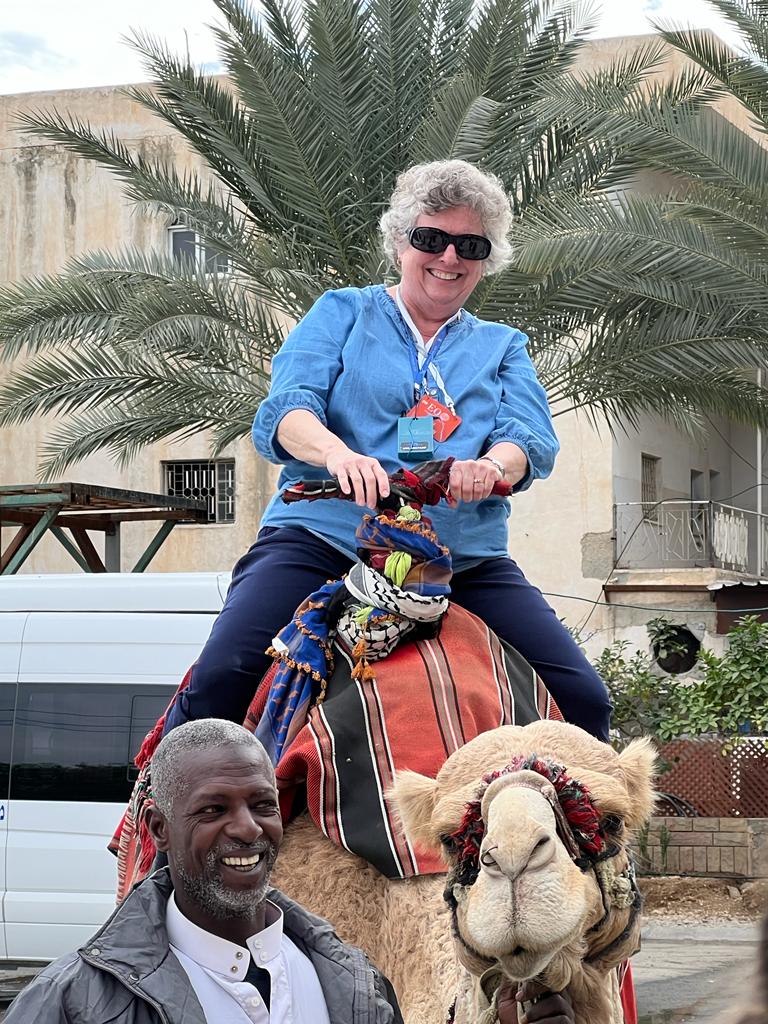
As I reflect on our recent trip to the Holy Land and its successes, I think one of the key ingredients was the OPEN HEARTS of the pilgrims that went with me. Everyone seemed ready to embrace new experiences, food, cultures, and meet new people.
I wonder what our “normal days” would be like if we approached them with the same openness of spirit.
One of the books I have been reading lately is the wonderful book by Lois Tverberg called Walking in the Dust of Rabbi Jesus: How the Jewish Words of Jesus Can Change Your Life. In it she lays out the common but unusual practice of how Jewish rabbis of that time taught their disciples – not with textbooks or course syllabus, but inviting them to literally follow them as they traveled and taught – to “walk after” them and learning from them by “covering yourself in his dust.” “You should follow so closely behind him as he traveled from town to town teaching that billows of sandy granules would cling to your clothes.”
Walking with Jesus, both literally and figuratively, was understood to be the way of a disciple. This is how your heart is changed. This would be how your overall lifestyle, your walk in life, would shift.
I was thankful for the openness with which those 18 pilgrims that went with me to the Holy Land engaged in this “walk.” They brought their whole selves – their joy, their willingness, their brokenness, their nervousness – all of it.
As we walked together, we certainly got good and dusty.
I pray that as you engage in your daily routine today, you look for ways that Jesus is inviting you to walk in his way. Is it listening extra hard to a friend in need and responding in grace? Is it turning from a craving to engage in more healthy behavior? Is it seeking more joy? Is it making a life change? Perhaps it has to do with nurturing a grateful heart.
In whatever way your walk in life goes today, may you walk with deliberateness in the footprints of the great Rabbi who is the Way, the Truth, and the Life.






 Matt's Morning Reflections